Beyond Tier 1: The Operational Challenges of Building Sustainable Quick-Commerce Logistics in Rural India
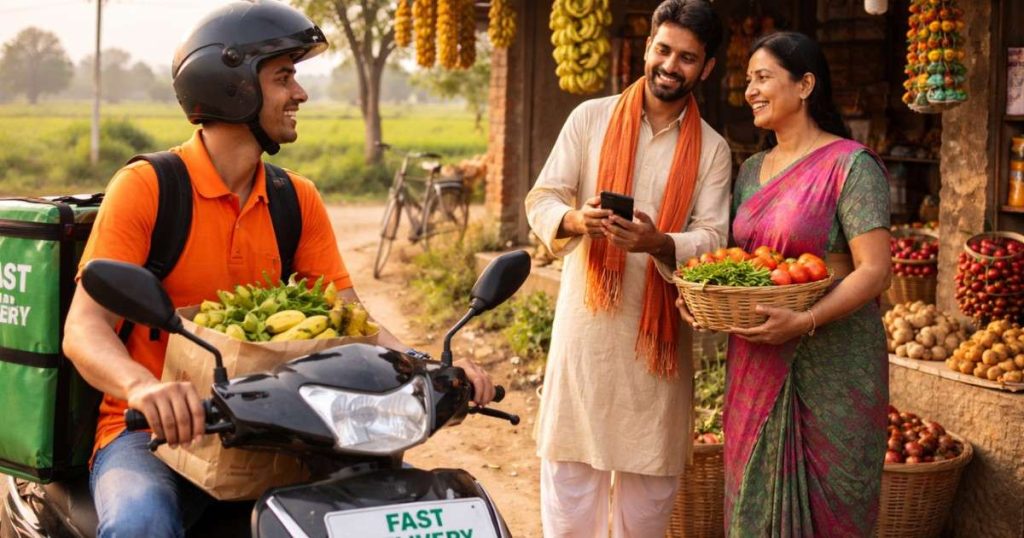
Quick-commerce meets rural India: navigating long distances, sparse demand, and limited infrastructure beyond urban markets.
India’s quick-commerce sector has become one of the most closely watched segments of the country’s digital economy. Platforms promising delivery of groceries and daily essentials within minutes have reshaped consumption habits in major cities, backed by large inflows of venture capital and aggressive network expansion. What began as an urban convenience has evolved into a broader debate about scale, sustainability and reach. As leading players explore growth beyond Tier-1 cities, attention is increasingly turning to rural India, where the realities of logistics, demand and infrastructure present a very different set of challenges.
In metropolitan regions, quick commerce thrives on density. High population concentration, predictable demand patterns and relatively developed transport networks allow companies to operate small, inventory-heavy fulfilment centres close to consumers. Orders are frequent, average delivery distances are short and costs can be spread across a large volume of transactions. These conditions enable platforms to justify investments in dark stores, cold-chain infrastructure and large delivery fleets. Rural India, however, does not offer these advantages at scale.
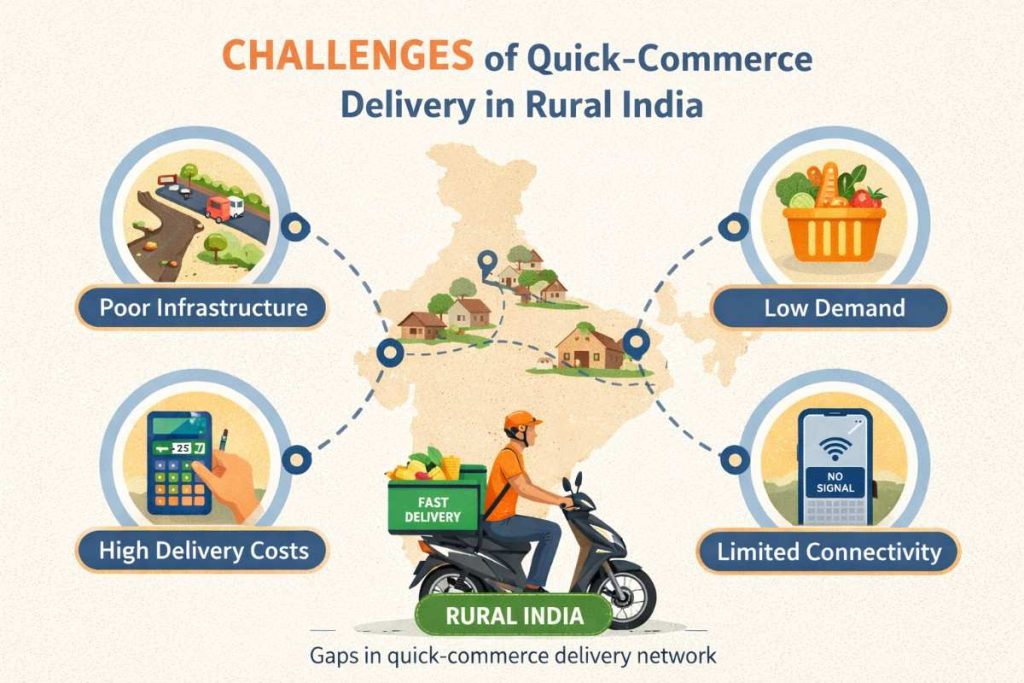
One of the most immediate obstacles is physical infrastructure. While national and state highways have expanded rapidly over the past decade, last-mile connectivity in many rural areas remains inconsistent. Village roads are often narrow, poorly maintained and vulnerable to seasonal disruptions during monsoons or extreme heat. Longer travel times and higher vehicle wear directly inflate delivery costs, making the promise of ultra-fast delivery difficult to fulfil without significant financial losses. For a model that relies on speed and efficiency, unpredictability in transit undermines both service quality and customer trust.
Warehousing and inventory management pose another structural challenge. Quick-commerce operations depend on strategically placed micro-warehouses stocked with fast-moving goods, including perishables such as dairy, fruits and vegetables. In rural areas, suitable commercial spaces are scarce, and reliable electricity supply remains uneven in many regions. Maintaining refrigeration and temperature-controlled storage becomes both expensive and operationally risky. Any breakdown in cold-chain continuity can lead to spoilage, wastage and reputational damage in markets where consumers are still developing confidence in online delivery for essential goods.
Demand patterns further complicate the equation. Rural consumers typically shop less frequently and in larger quantities, often planning purchases around weekly markets or monthly household needs. Price sensitivity is higher, and convenience alone is rarely sufficient to justify paying delivery fees or absorbing higher product prices. Quick commerce, by contrast, is designed around frequent, low-value orders driven by immediacy. Without sustained order volumes, the economics of rapid delivery collapse, forcing platforms to either subsidize operations heavily or dilute their service promises.
The workforce model that underpins quick commerce in cities also encounters friction outside urban centres. Delivery operations depend on a steady supply of gig workers comfortable with navigation apps, digital payments and performance-based incentives. In rural regions, digital literacy levels vary widely, smartphone penetration is uneven and alternative employment structures differ from urban gig economies. Recruiting, training and retaining delivery personnel becomes more complex, particularly when earnings fluctuate due to inconsistent demand.
Technology, often presented as the solution to logistics inefficiencies, has its own limitations in rural settings. Advanced demand forecasting, real-time inventory optimization and route planning rely on large datasets and stable internet connectivity. In areas where purchasing data is sparse and network coverage remains patchy, these systems struggle to deliver accuracy. Addressing systems in villages are also less standardized, adding friction to last-mile delivery and increasing reliance on local knowledge rather than algorithmic precision.
Beyond operational hurdles, the broader impact on local retail ecosystems cannot be ignored. Rural commerce in India has long been anchored by small, family-run kirana stores that operate on trust, credit and personal relationships. A poorly adapted quick-commerce expansion risks disrupting these networks without delivering proportional benefits to consumers or communities. Unlike urban neighbourhoods, where competition among multiple retail formats is common, villages often depend on a limited number of local shops for essential supplies.
Industry observers increasingly argue that sustainability in rural logistics will require fundamentally different models rather than a direct extension of urban playbooks. Hybrid approaches that integrate local retailers into digital supply chains, shared warehousing at block or district levels and delivery timelines measured in hours rather than minutes may be more realistic. Such models align better with rural consumption patterns while still leveraging technology to improve availability and transparency.
Policy context also matters. Government investments in rural roads, electrification and digital connectivity have improved baseline conditions, but gaps remain. Without continued public infrastructure development and regulatory clarity around gig work, cold-chain logistics and competition, private quick-commerce platforms will struggle to achieve scale responsibly outside major cities.
The push beyond Tier-1 markets reflects both ambition and necessity for India’s quick-commerce players as urban growth shows signs of maturing. Yet rural India demands patience, adaptation and a willingness to rethink assumptions about speed, scale and profitability. The future of quick commerce in these regions will not be defined by how fast groceries arrive at the doorstep, but by whether logistics systems can be built that are economically viable, socially integrated and resilient to the realities of rural life.
Add businessmax.in as preferred source on google – Click Here
Last Updated on: Wednesday, February 4, 2026 7:28 pm by Business Max Team | Published by: Business Max Team on Wednesday, February 4, 2026 7:28 pm | News Categories: Trending
About The Author