From Sensors to Sales: How the World Bank-Backed RAMP Scheme Is Modernizing 72 Million Indian MSMEs
Digital tools and smart manufacturing practices are helping Indian MSMEs improve productivity and expand market access under the World Bank-backed RAMP programme.
India’s vast network of micro, small and medium enterprises, long regarded as the backbone of the economy, is in the midst of a structural transformation. Quietly but decisively, millions of small factories, workshops and service firms are being pulled into a new era of digital operations, data-driven decision-making and expanded market access. Powering this shift is the Raising and Accelerating MSME Performance (RAMP) programme, a five-year reform initiative supported by the World Bank and implemented by the Government of India.
For decades, Indian MSMEs have been engines of employment and entrepreneurship, contributing close to a third of the country’s GDP and a significant share of exports. Yet they have also remained among the most vulnerable segments of the economy. Limited access to technology, finance, formal markets and institutional support meant that productivity remained uneven and growth potential often unrealised. The COVID-19 pandemic laid bare these structural weaknesses, disrupting supply chains, drying up cash flows and pushing thousands of small firms to the brink.
The RAMP scheme was conceived in this context, not merely as a recovery measure but as a long-term reform agenda. Unlike earlier support programmes that focused primarily on credit or subsidies, RAMP targets the foundations of MSME competitiveness: technology adoption, market integration, institutional coordination and policy coherence across states.
One of the most visible changes unfolding under the programme is on the factory floor itself. Traditionally, many small manufacturing units operated with ageing machinery and manual monitoring systems, relying on experience rather than data to manage production. Under RAMP-supported initiatives, MSMEs are beginning to adopt affordable sensors, digital meters and analytics tools that track machine performance, energy consumption and production quality in real time. For a small enterprise, this shift can mean fewer breakdowns, lower wastage and the ability to meet increasingly stringent quality and compliance standards demanded by large buyers and global supply chains.
These “smart factory” interventions are still at a pilot stage in several states, but early results suggest a powerful multiplier effect. When a micro-enterprise gains visibility into its own operations through data, it becomes easier to improve efficiency, negotiate better terms with buyers and access formal finance. What was once an informal workshop starts to resemble a modern production unit, capable of scaling and integrating with larger industrial ecosystems.
Modernization under RAMP, however, goes far beyond machines and sensors. The programme recognises that production gains mean little if MSMEs cannot sell efficiently. A major thrust of the scheme is therefore on market access, particularly through digital channels. Small firms that once depended entirely on local traders or physical markets are being helped to build digital catalogues, standardise packaging and logistics, and onboard onto e-commerce and digital trade networks. This shift is enabling MSMEs to reach customers far beyond their immediate geography, often for the first time.
For many entrepreneurs, especially women-owned and micro enterprises, this digital exposure has proven transformative. Access to online platforms reduces dependence on intermediaries, improves price discovery and creates opportunities to build brand identity. In an economy where consumption and procurement are increasingly moving online, such integration is no longer optional but essential for survival.
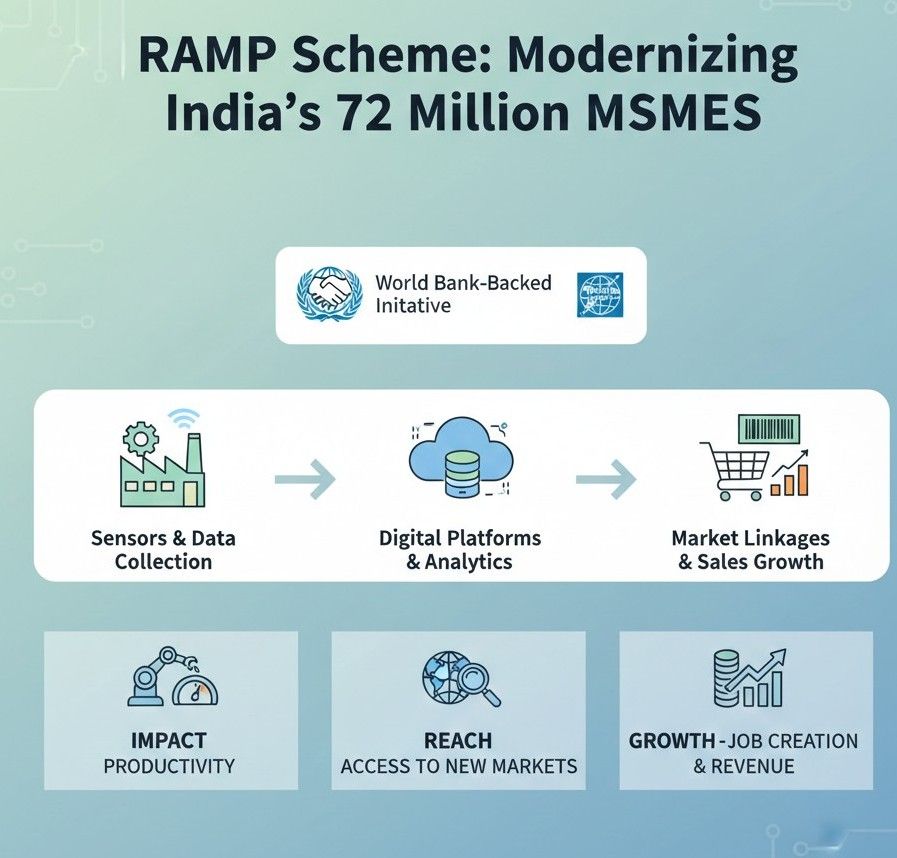
Equally important, though less visible, is RAMP’s focus on strengthening institutions that support MSMEs. The scheme works through both central and state governments, encouraging coordinated policy action rather than fragmented interventions. States are being supported to develop strategic investment and reform plans tailored to local industrial clusters, ensuring that national objectives align with regional realities. This approach marks a departure from one-size-fits-all schemes of the past.
Access to finance remains a chronic challenge for small businesses, and here too RAMP seeks systemic solutions. By improving credit information systems, strengthening receivables financing mechanisms and addressing the persistent problem of delayed payments, the programme aims to make MSMEs more bankable and reduce their dependence on informal credit. When combined with better operational data and digital records, these reforms have the potential to unlock capital for enterprises that were previously excluded from formal lending.
Sustainability is another emerging dimension of the programme. RAMP encourages the adoption of energy-efficient and environmentally friendly technologies, helping MSMEs reduce costs while aligning with global sustainability norms. As international buyers increasingly demand green and traceable supply chains, such measures are becoming critical for export-oriented small firms.
The scale of ambition is striking. While direct interventions under RAMP target hundreds of thousands of enterprises during the programme period, the broader reform agenda is designed to influence the entire MSME ecosystem, estimated at around 72 million units nationwide. By changing how policies are implemented, how technology is accessed and how markets are reached, the programme aims to create a ripple effect far beyond its immediate beneficiaries.
It is still early to declare final outcomes, and challenges remain. Digital literacy gaps, uneven state capacity and the sheer diversity of India’s MSME landscape mean that progress will not be uniform. Yet the direction of change is unmistakable. From sensor-enabled shop floors to online sales channels, from informal bookkeeping to data-backed credit access, India’s MSMEs are being nudged toward a future where size is no longer a barrier to sophistication.
In a global economy defined by technology, speed and integration, the survival of small enterprises depends on their ability to adapt. The World Bank-backed RAMP scheme represents one of India’s most comprehensive attempts to ensure that its smallest businesses are not left behind. If successful, it could redefine the role of MSMEs in the country’s growth story, transforming them from vulnerable participants into competitive, modern engines of economic expansion.
Add businessmax.in as preferred source on google – Click Here
Last Updated on: Thursday, January 29, 2026 2:32 pm by Business Max Team | Published by: Business Max Team on Thursday, January 29, 2026 2:32 pm | News Categories: Latest News, Trending
About The Author