The Founder’s Guide to Navigating Secondary Stake Sales and Liquidity Events in Private Markets

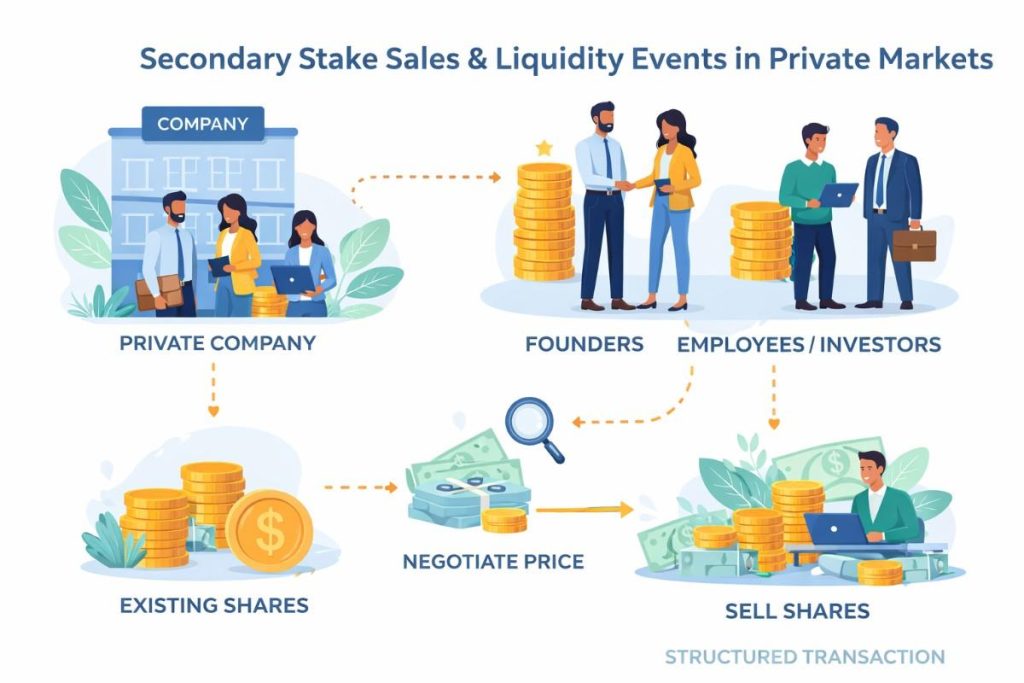
Illustration representing secondary stake sales and liquidity events in private markets.
For years, startup liquidity followed a familiar arc. Founders raised capital privately, scaled fast, and eventually delivered returns through an IPO or a strategic acquisition. That linear journey has become far less predictable. Public markets have grown volatile, listing timelines have stretched, and many high-quality startups are choosing to remain private for longer. In this new reality, secondary stake sales and structured liquidity events have quietly emerged as a central feature of private-market strategy rather than a niche exception.
Secondary transactions, which involve the sale of existing shares rather than the issuance of new ones, are now playing a critical role in how founders, employees, and early investors manage risk and rewards. Market data from global cap table and equity administration platforms shows that secondary transaction volumes in venture-backed companies have, in several recent periods, rivalled or exceeded the value created through IPO exits. This shift signals a deeper structural change: liquidity is no longer reserved for the end of a company’s lifecycle. It is increasingly woven into its middle years.
For founders, this evolution brings both opportunity and responsibility. While secondary sales can relieve personal financial pressure, improve employee retention, and professionalise a company’s ownership structure, they also introduce complexity around governance, valuation, tax, and perception. Navigating this terrain requires more than opportunistic deal-making; it demands the same strategic discipline that founders apply to fundraising and long-term growth.
At its core, a secondary stake sale allows an existing shareholder to sell shares to another investor, often with company and board approval. The most common form in private markets is the tender offer, where the company facilitates a time-bound opportunity for eligible shareholders, frequently employees or early investors, to sell a portion of their holdings at a fixed price. Other structures include negotiated founder secondaries alongside primary funding rounds or periodic liquidity programs designed to coincide with major milestones.
The rise of these mechanisms is closely tied to the “late IPO” era. Many startups now take ten years or more to reach public markets, even as their valuations and headcounts grow significantly in private hands. Employees holding stock options may wait far longer than earlier generations to realise value, while early investors face pressure from their own fund timelines. In this context, secondary liquidity has become a practical solution to competing expectations without forcing a premature exit.
Founders, however, must begin with a clear understanding of purpose. The first question boards and investors ask is why the liquidity event is being proposed. Is it to reward long-serving employees, to offer partial exits to early backers, to reduce founder concentration risk, or to tidy up a complex cap table before a future IPO? Each motivation carries different implications, and misalignment between intent and execution can quickly erode trust.
Equally important is deciding who gets access to liquidity and in what proportion. Well-governed companies typically impose limits on how much any individual can sell, often allowing only a percentage of vested holdings to change hands. Many boards prefer employee-focused liquidity windows before approving founder secondaries, particularly in companies that are still scaling aggressively. The underlying concern is not moral but strategic: large founder sell-downs, if poorly timed or communicated, can raise questions about long-term commitment and confidence in the business.
Pricing is often the most sensitive element of any secondary transaction. Unlike public markets, where price discovery is continuous, private-market pricing carries symbolic weight. A tender offer price can become a reference point for employee morale, investor negotiations, and future fundraising. If set too low relative to recent primary rounds, it may disappoint shareholders. If set too high, it can create friction with new investors or invite scrutiny over valuation discipline. Successful founders focus less on finding a “perfect” number and more on ensuring that the price is defensible, transparent, and consistent with the company’s recent capital history.
Control and governance remain central concerns. Secondary sales can introduce new shareholders into a company, potentially altering dynamics at the board or cap table level. This risk is usually managed through transfer restrictions embedded in shareholder agreements and articles of association, which require company consent and limit who can acquire shares. In jurisdictions like India, where private companies are expected to restrict share transfers, these controls are not merely best practice but a legal necessity. Founders who treat secondaries as informal side deals risk undermining the very governance structures that support long-term value creation.
Operational details also matter more than many founders initially realise. In India, regulatory changes around dematerialisation have pushed many private companies toward electronic shareholding records, aligning them more closely with public-market standards. Clean, dematerialised ownership records reduce friction during liquidity events and help prevent disputes over entitlement and transfer validity. At the same time, regulators have repeatedly cautioned against informal trading of unlisted shares on unauthorised platforms, reinforcing the need for structured, compliant liquidity pathways.
Cross-border shareholding adds another layer of complexity. When shares are transferred between residents and non-residents, foreign exchange regulations and reporting obligations come into play. These transactions often require valuation support and timely filings through authorised banking channels. While such requirements are manageable with the right advisory support, founders who underestimate timelines and compliance costs can find liquidity events delayed or partially executed.
Taxation is another area where expectations and reality often diverge. Liquidity does not automatically translate into net personal gain. For employees, equity instruments may be taxed at multiple stages, including at exercise and at sale. For founders and early shareholders, capital gains treatment depends on holding periods, share classification, and transaction structure. Changes in tax treatment of buybacks and related corporate actions over recent years underline the importance of designing liquidity events with current law in mind rather than relying on outdated assumptions.
Perhaps the most underestimated aspect of secondary transactions is communication. Liquidity events send powerful signals inside an organisation. When handled well, they reinforce trust, reward contribution, and reaffirm confidence in the company’s future. When handled poorly, they fuel rumours, resentment, and disengagement. Clear communication around eligibility, pricing, timing, and rationale is essential, particularly in employee tender offers where equity compensation is closely tied to morale.
As private markets mature, secondary stake sales are becoming institutional rather than exceptional. They are no longer viewed solely as exits, but as tools that allow companies to remain private while managing the legitimate financial needs of those who built them. The founders who succeed in this environment are those who treat liquidity with the same seriousness as capital raising, product strategy, and governance. For them, secondary sales are not about cashing out early, but about building resilient, long-lived companies where value creation and value realisation move forward together.
Also read : How to Build a ‘Profitable-First’ SaaS: Lessons from India’s Newest Bootstrapped Unicorns
Add businessmax.in as preferred source on google – Click here
Last Updated on: Thursday, February 5, 2026 11:04 am by Business Max Team | Published by: Business Max Team on Thursday, February 5, 2026 11:04 am | News Categories: Business, Trending
About The Author