What Startup Leaders Should Know About Hiring Senior Talent in a Competitive Job Market
"Startup leaders interviewing senior talent in a modern office setting, highlighting strategies for hiring experienced professionals in a competitive job market."
As competition for experienced professionals intensifies across industries, startup founders and leadership teams are facing growing challenges in hiring senior talent. With demand for seasoned executives outpacing supply, particularly in technology, finance, operations, and growth roles, the process of attracting and retaining leadership talent has become a strategic priority for startups navigating an uncertain economic environment.
Industry experts note that the dynamics of senior hiring have shifted significantly in recent years. Experienced professionals now have more options, greater bargaining power, and higher expectations from potential employers. For startups, this means traditional hiring approaches are no longer sufficient.
Rising Demand, Limited Supply
The global startup ecosystem has matured rapidly, leading to a surge in demand for leaders who can scale businesses, manage complexity, and deliver sustainable growth. Senior professionals with proven track records are being courted not only by startups but also by established enterprises, global technology firms, and private equity-backed companies.
This imbalance has made hiring timelines longer and decision-making more competitive. Startups that fail to act decisively or communicate clearly often lose candidates to faster-moving organizations.
Clarity of Role Becomes Critical
One of the key factors influencing senior hiring outcomes is role clarity. Unlike early-stage employees who may be comfortable wearing multiple hats, senior leaders expect well-defined responsibilities, authority levels, and performance expectations.
Recruitment specialists point out that vague job descriptions and unclear reporting structures often deter experienced candidates. Senior professionals are increasingly focused on understanding how their role fits into the broader organizational strategy and what success will look like in measurable terms.
Beyond Pay: The Evolving Compensation Conversation
While compensation remains an important factor, it is no longer limited to salary alone. Startups frequently rely on a mix of fixed pay, equity, and performance-based incentives to attract senior leaders. However, transparency around equity structure has become a decisive element in negotiations.
Candidates are seeking clear explanations on valuation, vesting schedules, dilution risks, and long-term exit possibilities. Any lack of clarity in these discussions can undermine confidence, even when the overall offer appears attractive.
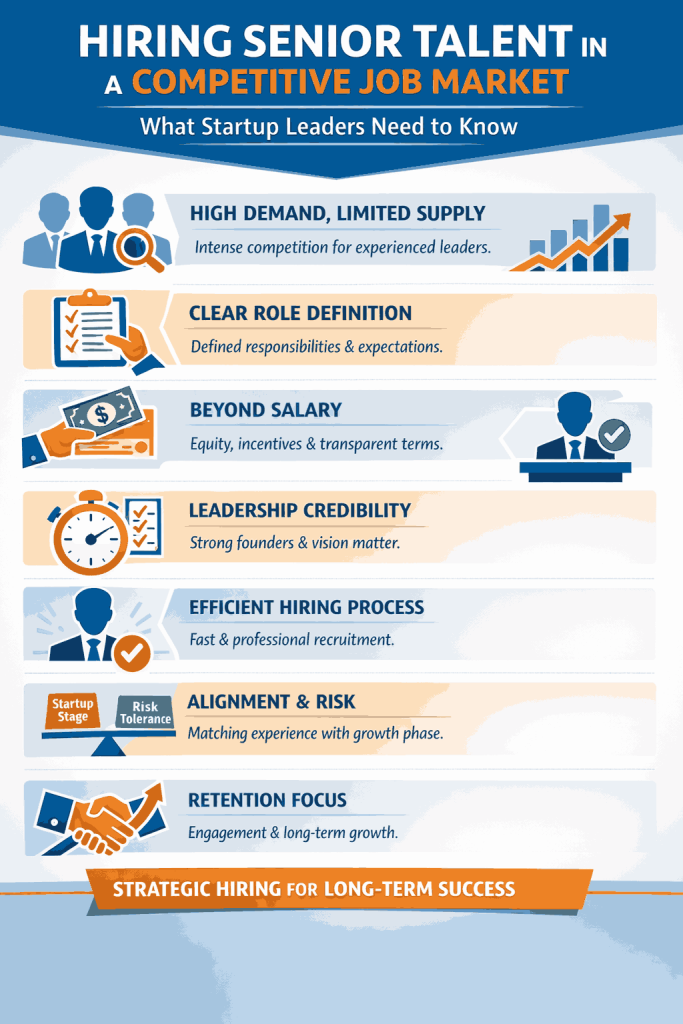
Leadership Credibility Under Scrutiny
For senior hires, the quality and credibility of the founding team play a major role in decision-making. Experienced professionals often assess whether founders are open to delegation, capable of strategic thinking, and willing to evolve leadership styles as the company grows.
Reports from hiring consultants suggest that concerns around micromanagement, inconsistent decision-making, or lack of governance continue to be among the top reasons senior candidates decline startup offers.
Hiring Process Signals Organizational Maturity
In a competitive job market, the hiring process itself has become a signal of a startup’s operational maturity. Structured interviews, timely communication, and clear next steps are increasingly viewed as indicators of how the company functions internally.
Delays, frequent changes in expectations, or lack of feedback are often interpreted as warning signs. Senior candidates, many of whom manage multiple offers simultaneously, tend to favor organizations that demonstrate professionalism and decisiveness.
Alignment on Risk and Growth Stage
Not all senior professionals are suited to every stage of a startup’s journey. Industry observers highlight the importance of aligning a candidate’s experience with the company’s current phase—whether early-stage, growth-stage, or pre-IPO.
Mismatch in risk appetite or expectations around stability can lead to early exits, which are costly for startups both financially and strategically. Clear communication about challenges, funding runway, and growth plans has therefore become essential during hiring discussions.
Retention Starts Early
Retention of senior talent is emerging as a growing concern for startups, particularly as leadership turnover can disrupt momentum. Experts emphasize that retention begins well before onboarding, through transparent conversations, realistic expectations, and early involvement in strategic planning.
Senior leaders increasingly seek long-term growth opportunities, influence in decision-making, and a sense of ownership in the company’s future. Startups that fail to provide these elements often struggle to retain top leadership talent.
A Strategic Imperative for Startups
As competition for senior talent continues to intensify, hiring experienced leaders is no longer viewed as a routine recruitment exercise but as a strategic imperative. The right leadership hires can strengthen governance, improve execution, and enhance investor confidence, while poor hiring decisions can slow growth and strain internal culture.
In an increasingly competitive job market, startup leaders who prioritize clarity, transparency, and alignment are better positioned to attract senior professionals capable of guiding their organizations through the next phase of growth.
Add businessmax.in as a preferred source on google – Click here
Last Updated on: Thursday, January 22, 2026 11:07 am by Business Max Team | Published by: Business Max Team on Thursday, January 22, 2026 11:06 am | News Categories: Startup
About The Author