From Copilots to Agents: How Autonomous AI Workflows Are Redefining Indian SaaS in 2026
From copilots to agents: Autonomous AI workflows transform how Indian SaaS companies build, scale, and deliver enterprise outcomes in 2026.
In 2026, the Indian SaaS industry is undergoing one of its most significant transformations since the cloud boom of the last decade. What began as a wave of AI copilots assistive tools designed to support human decision-making has rapidly evolved into a new era of autonomous AI agents capable of executing complex workflows with minimal human intervention. This shift is not just a technological upgrade; it represents a fundamental rethinking of how software is built, sold, and used across enterprises in India and globally.
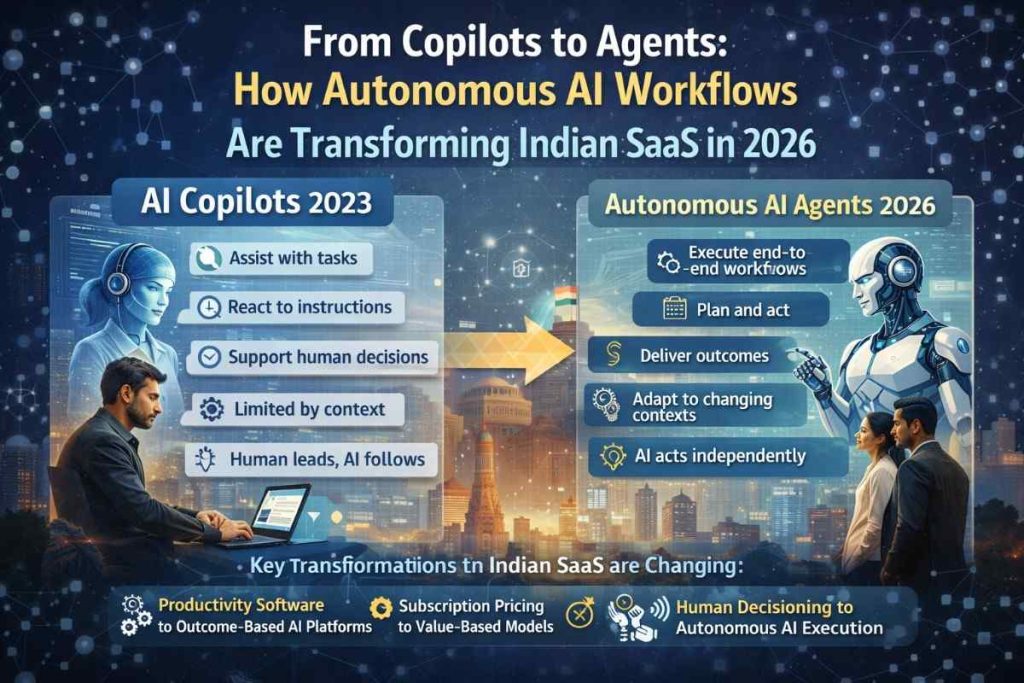
For years, Indian SaaS companies focused on efficiency, affordability, and scalability to compete with global players. AI copilots fit neatly into this model. They helped sales teams draft emails, enabled developers to write code faster, assisted HR teams in screening resumes, and supported customer service agents with suggested responses. However, copilots were inherently reactive. They waited for prompts, operated within narrow boundaries, and relied heavily on humans to initiate and complete tasks.
By 2026, that limitation has become increasingly apparent. Enterprises no longer want software that merely assists; they want systems that act. This demand has accelerated the adoption of autonomous AI workflows—intelligent agents that can plan, decide, and execute multi-step processes across different systems without continuous human oversight. For Indian SaaS founders, this transition has opened both unprecedented opportunities and complex challenges.
At the heart of this shift is a change in how value is delivered. Traditional SaaS sold productivity. Copilots sold speed. Autonomous agents sell outcomes. Instead of offering a CRM tool that helps sales representatives track leads, Indian SaaS platforms are now offering AI agents that can identify high-intent prospects, initiate outreach, follow up automatically, negotiate basic terms, update records, and alert humans only when strategic decisions are required. The software is no longer a tool; it is a digital worker.
This evolution has been particularly impactful in India’s strong SaaS verticals such as fintech, HR tech, customer support, and supply chain management. In fintech SaaS, autonomous AI agents are managing compliance checks, fraud detection workflows, and loan underwriting processes end-to-end. Rather than flagging potential risks for human review, these agents assess data in real time, apply regulatory logic, communicate with external systems, and approve or reject transactions within defined guardrails. Human teams step in only for exceptions or policy changes.
HR and people operations software, another Indian SaaS stronghold, has also been reshaped. Recruitment platforms now deploy AI agents that source candidates, evaluate skills using live assessments, schedule interviews, and even conduct initial screening conversations through voice and video. Performance management tools use autonomous agents to track employee goals, analyze productivity patterns, recommend learning paths, and trigger interventions before burnout or attrition occurs. The role of HR professionals is shifting from operational execution to strategic oversight.
Customer experience has emerged as one of the most visible beneficiaries of autonomous AI workflows. Indian SaaS companies serving global customers have moved beyond chatbots and scripted responses. AI agents now handle entire customer journeys onboarding new users, resolving complex support tickets, processing refunds, coordinating with engineering teams for bug fixes, and proactively reaching out when usage patterns suggest dissatisfaction. These systems learn continuously, improving resolution quality without manual retraining for every scenario.
The rise of autonomous agents has also changed how Indian SaaS products are built. Architecture has shifted from monolithic applications to agent-centric systems that integrate large language models, domain-specific intelligence, APIs, and real-time data streams. Workflow orchestration has become a core competency. SaaS platforms are increasingly designed as ecosystems of specialized agents each responsible for a specific function—coordinated by a central decision layer. This modular approach allows companies to scale intelligence, not just infrastructure.
For Indian founders, this transition has reinforced the importance of deep domain expertise. Generic AI capabilities are no longer enough. The most successful SaaS companies in 2026 are those that combine autonomous AI with a nuanced understanding of industry-specific workflows, regulatory environments, and customer behavior. In sectors like healthcare, banking, and logistics, trust and compliance are critical. Indian SaaS firms that embed local and global regulatory intelligence into their agents are gaining a competitive edge in international markets.
However, the move from copilots to agents has not been without friction. Enterprises are understandably cautious about handing over critical workflows to autonomous systems. Concerns around data security, explainability, accountability, and bias remain front and center. Indian SaaS companies have had to invest heavily in transparency features dashboards that show why an agent made a decision, audit trails for regulatory reviews, and human-in-the-loop controls that allow intervention when needed.
Pricing models are also evolving. Subscription-based SaaS pricing, traditionally linked to seats or usage, is giving way to outcome-based and value-based models. Customers are less interested in how many users log in and more focused on how many tasks are completed, how much cost is saved, or how much revenue is generated by AI agents. This shift aligns well with autonomous workflows but requires SaaS companies to rethink revenue predictability and customer success metrics.
From a talent perspective, the transformation is redefining roles within Indian SaaS companies themselves. Demand for prompt engineers and basic AI integrators has plateaued, while the need for AI architects, workflow designers, applied ML engineers, and ethics and governance specialists has surged. Teams are smaller but more specialized, focusing on supervising intelligent systems rather than performing repetitive tasks.
On the global stage, India’s SaaS ecosystem is benefiting from this transition. Autonomous AI workflows have reduced the traditional disadvantages of time zones and manpower constraints. Indian companies can now serve global clients with always-on digital agents that deliver consistent performance. This has strengthened India’s position not just as a SaaS outsourcing hub, but as a source of full-stack, AI-native enterprise platforms.
As 2026 unfolds, it is becoming clear that the era of AI copilots was only a stepping stone. Autonomous agents are redefining what software means for businesses transforming applications into active participants in organizational decision-making. For Indian SaaS, this shift marks a coming of age. The companies that successfully balance autonomy with trust, intelligence with control, and innovation with responsibility are not just adapting to the future of work they are building it.
Add businessmax.in as preferred source on google- Click Here
Last Updated on: Tuesday, January 27, 2026 9:59 am by Business Max Team | Published by: Business Max Team on Tuesday, January 27, 2026 9:58 am | News Categories: Trending, Startup
About The Author