Best Fractional CMO Services for Startups: How to Scale Marketing Without a Full-Time Hire

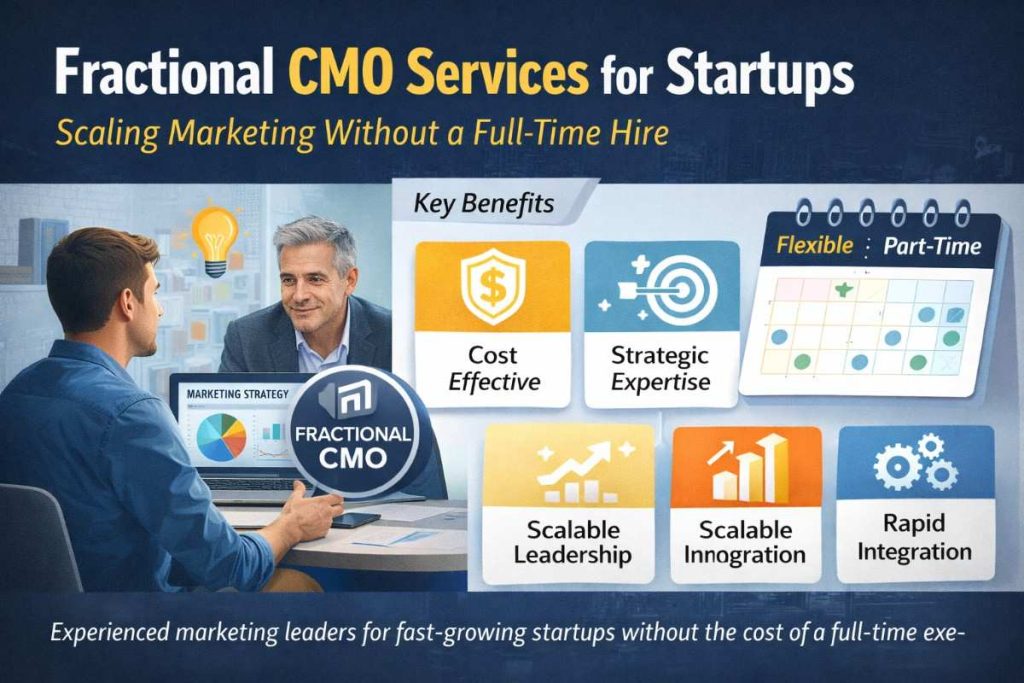
Fractional CMOs are emerging as a strategic alternative for startups seeking senior marketing leadership without the cost of a full-time executive.
In the high-pressure world of startups, marketing has emerged as both a growth engine and a persistent bottleneck. Founders are expected to build brand credibility, drive demand, manage performance channels, and articulate a compelling growth story for investors—all while conserving cash and maintaining operational agility. For many early- and mid-stage startups, the idea of hiring a full-time Chief Marketing Officer remains aspirational rather than practical. It is within this gap that fractional CMO services have quietly evolved from a niche solution into a mainstream strategic choice.
A fractional CMO is, in essence, an experienced marketing leader who works with a company on a part-time, interim, or contract basis. Unlike consultants who deliver decks and disengage, fractional CMOs typically embed themselves into the leadership team, shaping strategy, overseeing execution, and mentoring internal talent. The model has gained rapid traction across SaaS, consumer tech, fintech, healthtech, and deep-tech startups, particularly as capital efficiency has become a defining theme of the current funding cycle.
The appeal is straightforward. Hiring a seasoned full-time CMO can cost startups a substantial salary, equity dilution, and long-term commitment at a stage when both strategy and market direction are still evolving. Fractional CMOs offer access to senior-level thinking without the financial and organizational burden of a permanent executive hire. For founders navigating product-market fit, go-to-market complexity, or stalled growth, this flexibility can be decisive.
What differentiates fractional CMOs from agencies or junior marketing hires is the nature of their involvement. These professionals are typically former CMOs or VPs of Marketing who have scaled companies across stages, weathered market cycles, and aligned marketing strategy with revenue, product, and sales. Their work often begins with diagnosing the company’s real marketing problem, which is frequently not a lack of activity but a lack of focus. Many startups are running campaigns, publishing content, and spending on ads without a coherent narrative or measurable return. A fractional CMO brings structure to this chaos, clarifying positioning, defining the ideal customer profile, and aligning messaging with business objectives.
In practice, the engagement often starts with sharpening the startup’s story. In crowded markets, differentiation is rarely about features alone. Fractional CMOs help founders articulate why the company exists, who it is truly for, and why it matters now. This clarity cascades across brand identity, website messaging, sales collateral, and investor communications. For startups preparing to raise capital, this narrative discipline can significantly influence how investors perceive momentum and market opportunity.
Beyond storytelling, fractional CMOs play a critical role in building scalable growth systems. Rather than chasing every available channel, they prioritize what works at a given stage. For an early-stage B2B startup, that might mean refining founder-led sales and thought leadership before investing heavily in paid acquisition. For a consumer-facing company, it could involve tightening retention loops before scaling user acquisition. The emphasis is not on growth at all costs but on repeatable, measurable growth that aligns with available resources.
One of the most overlooked benefits of fractional CMO services is their impact on internal teams. Startups often hire marketers who are capable but under-supported, lacking senior mentorship or strategic direction. A fractional CMO fills this leadership gap, setting goals, defining processes, and creating accountability without overwhelming the team. Over time, this helps startups professionalize their marketing function, making it easier to transition to a full-time CMO role when the company is ready.
The market for fractional CMO services has expanded rapidly in response to this demand. Some providers operate as boutique firms, offering carefully matched CMOs based on industry and growth stage. Others blend executive leadership with execution teams, ensuring that strategy does not stall due to bandwidth constraints. There are also independent fractional CMOs who work directly with founders, often bringing highly specialized experience in areas such as enterprise SaaS, marketplaces, or international expansion. While the delivery models differ, the underlying promise remains consistent: senior marketing leadership without the rigidity of traditional hiring.
Timing is crucial when engaging a fractional CMO. The model tends to work best for startups that have a validated product and early traction but are struggling to scale efficiently or articulate a clear growth strategy. Companies that are preparing for a funding round, entering a new market, or experiencing diminishing returns from existing channels often see the fastest impact. Conversely, startups that are still exploring whether a real market exists may benefit more from short-term advisory support before committing to ongoing fractional leadership.
As startup ecosystems mature and funding environments fluctuate, the rise of fractional executives reflects a broader shift in how companies think about leadership. Marketing, once viewed as a downstream function focused on promotion, is increasingly recognized as a strategic discipline tied directly to revenue, valuation, and long-term resilience. Fractional CMOs embody this shift, offering founders a way to access strategic depth without sacrificing agility.
Looking ahead, fractional marketing leadership is likely to become even more normalized. As remote work, portfolio careers, and outcome-driven engagements reshape executive work itself, startups may increasingly view fractional CMOs not as a compromise, but as a competitive advantage. In an era where speed, clarity, and capital efficiency define success, the ability to plug in experienced leadership exactly when it is needed may prove to be one of the smartest growth decisions a startup can make.
Add businessmax.in as preferred source on google – Click here
Last Updated on: Monday, February 2, 2026 3:51 pm by Business Max Team | Published by: Business Max Team on Monday, February 2, 2026 3:51 pm | News Categories: Business, Trending
About The Author